
Why do some fractures need surgery?
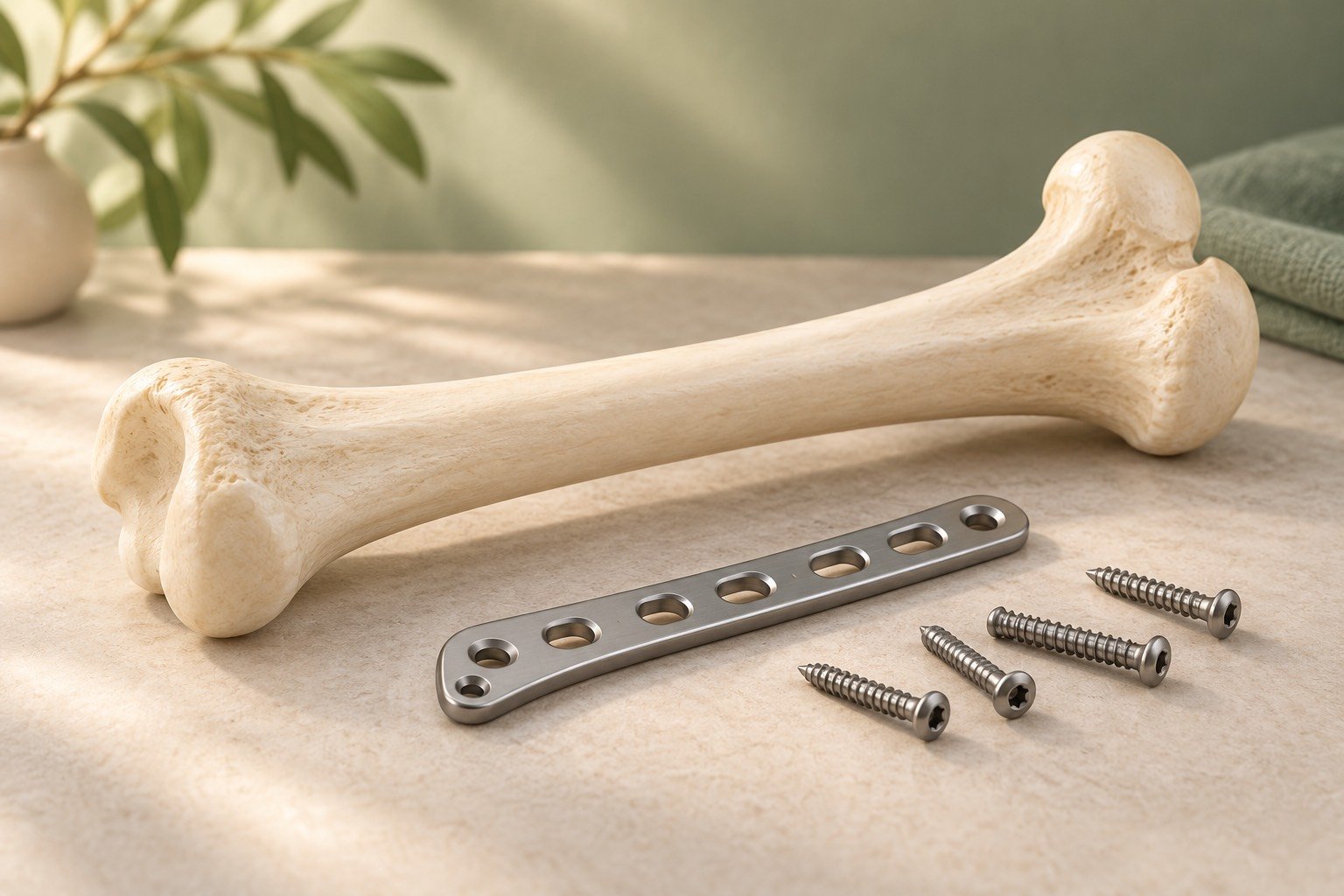
AI-generated illustration. This is not a real patient or a diagnostic image.
Bone is living tissue that can repair itself under appropriate conditions. Some fractures nevertheless need surgery because the goal is not simply to achieve union, but to heal in an acceptable position with the best possible function.
What can surgery achieve?
Plates, screws or nails can help hold fragments in suitable alignment. Congruity matters when a fracture enters a joint; length, angulation and rotation matter in long bones. Open fractures, vascular injuries and some unstable injuries may have a different degree of urgency.
Stable fixation may allow earlier joint movement and rehabilitation in suitable patients. However, surgery does not always accelerate the biological repair process, and infection and other surgical risks must be considered.
Does every fracture need an operation?
No. Some fractures are treated with a cast, splint, brace or monitored observation. The choice depends on the location, displacement, surrounding soft tissues and the patient's condition.
Having had surgery does not, by itself, determine when it is safe to put weight through the limb. Follow the loading and rehabilitation plan set by the treating team.
Sources
This article provides general information. Individual diagnosis and treatment require a clinical assessment.